
Choosing the Right Vacuum Gauges: What Most Buyers and Engineers Get Wrong
If you have worked around vacuum systems long enough, you start noticing a pattern.
Most systems don’t fail because the pump is weak.
They fail because nobody really understood what was happening inside the chamber.
Pressure readings were wrong.
Gauges were installed in the wrong place.
Controllers were poorly configured.
Warnings were ignored.
And slowly, performance dropped.
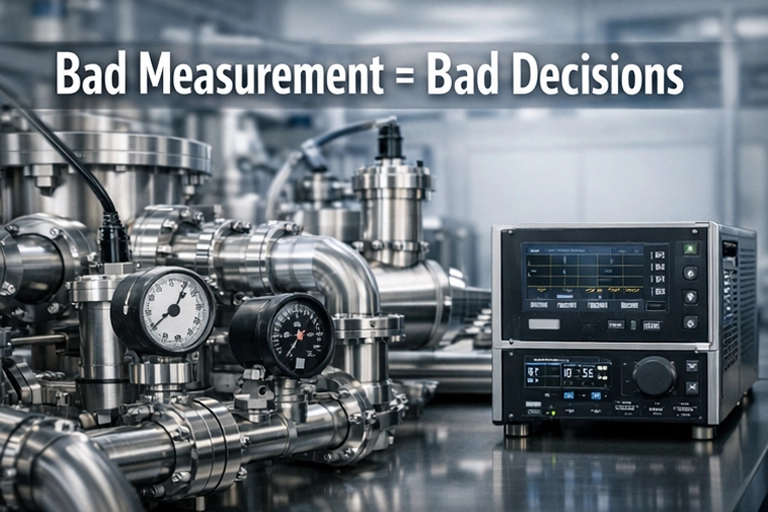
This is why vacuum gauges, controllers, and display units are not “accessories.”
They are decision-making tools.
If you get them wrong, everything else suffers.
The Biggest Mistake: Treating All Gauges the Same
Many buyers assume:
“A gauge is a gauge. If it shows pressure, it’s enough.”
In reality, this thinking causes most long-term problems.
Different vacuum ranges need different technologies. Using the wrong gauge is like using a kitchen thermometer in a furnace.
It may show something — but it won’t help you.
Pirani gauges are usually the first ones installed in a system.
They tell you:
When pumping starts
How fast pressure is dropping
When it’s safe to move to high vacuum
In real plants, Pirani gauges are often over-trusted.
They are excellent for rough and medium vacuum, but once you move deeper, their readings become unreliable.
Many systems look “fine” on Pirani — until problems appear later.
Penning gauges come into play when things get serious.
They operate in high vacuum ranges and are far more sensitive to small changes.
In many labs and coating systems, engineers first realize there is a leak only because the Penning gauge doesn’t stabilize.
It’s not dramatic.
It’s subtle.
Pressure takes longer to settle.
Base vacuum is slightly higher.
Process quality drops slowly.
This is how most vacuum issues start.

In ultra-high vacuum environments, there is no room for guesswork.
Research labs, semiconductor fabs, and surface science facilities depend on UHV gauges because:
At these levels, even fingerprints, moisture, or tiny material defects matter.
We’ve seen systems where everything looked perfect — except the UHV gauge showed instability.
That single reading saved weeks of wasted experiments.
Here’s a hard truth:
Many systems use expensive gauges and cheap controllers.
This is like buying a luxury car and installing a poor-quality dashboard.
Controllers decide:
How signals are processed
When gauges turn on/off
How alarms work
How data is logged
Bad controllers cause:
Signal noise
Wrong switching
False alarms
Operator confusion
Good controllers quietly keep everything stable.
Most failures don’t happen in hardware.
They happen when someone reads the display and makes a wrong decision.
If the display is unclear, badly placed, or confusing, mistakes happen.
Good display units:
Show data clearly
Highlight abnormal values
Reduce reaction time
Improve safety
This matters more than most people realize.

Installation: Where Good Systems Become Bad
We’ve seen perfect gauges give useless data.
Why?
Wrong installation.
Common mistakes:
Mounted too close to pumps
Placed in high gas-flow zones
Exposed to contamination
Poor electrical grounding
One wrong location can make a high-end gauge useless.
How Smart Buyers and Engineers Choose
Experienced teams don’t ask:
“What’s the cheapest gauge?”
They ask:
What range do we really operate in?
What gases are involved?
How stable does this need to be?
How automated is the system?
Who will maintain it?
Then they choose:
Pirani + Penning + UHV (if needed)
Good controller
Clear display
Correct placement
Simple. Effective. Reliable.

Most vacuum problems don’t start with breakdowns.
They start with bad data.
Wrong readings → wrong decisions → slow failures.
If you invest in proper measurement and control from the beginning, your system will reward you with stability, confidence, and long-term performance.
That’s not theory.
That’s experience.


This post hits the nail on the head regarding ‘range overlap’ mistakes. We recently had an issue where our Pirani gauge was providing wildly different readings compared to our Capacitance Manometer at the 10⁻³ mbar crossover point. Is this typically due to the gas sensitivity factor of the Pirani, or should we be looking for a potential local leak near the gauge port?
That is an excellent observation regarding the 10⁻³ bar crossover point. In our experience at UltraHiVac, this is one of the most common points of confusion in vacuum system calibration.To answer your question: It is almost certainly the gas sensitivity factor of the Pirani gauge. >Pirani gauges are ‘indirect’—they calculate pressure based on the thermal conductivity of the gas. Since different gases (like Argon or Helium) conduct heat differently than Nitrogen/Air, the Pirani will give a ‘false’ reading if your gas composition isn’t pure. A Capacitance Manometer, however, is a ‘direct’ gauge; it measures the physical force on a diaphragm, making it gas-independent and much more accurate as a reference at that specific pressure level.Before checking for a leak, I would recommend:Check your Gas Type: If you are backfilling with Argon, your Pirani will be off by a factor of ~0.6.Gauge Orientation: Ensure the Pirani isn’t mounted in a way that allows ‘convection’ to interfere with the filament.Crossover Logic: We usually recommend setting your PLC/Controller to prioritize the Capacitance Manometer once you drop below 10⁻2 mbar to avoid this exact discrepancy.If you are still seeing a massive drift after accounting for gas type, feel free to share your system volume and we can look into the leak rate possibilities!
Thanks for the advice on the 90-degree elbow! That definitely helped with the stability. However, we noticed that after the last bake-out, the emission current on our Ion Gauge is struggling to stay constant. Could this be a sign of filament contamination, or is it possible the grid has become slightly warped from the thermal stress?
Glad to hear the elbow trap improved your stability, Rajesh!Regarding the emission current issues: at 10⁻⁷ mbar and below, the filament is very sensitive.Filament Contamination: This is the most likely culprit. If there were any trace hydrocarbons or pump oil backstreaming during the bake-out, they can ‘poison’ the filament (typically yttria-coated iridium or tungsten). This increases the work function, making it harder to emit electrons.Grid Warping: While less common, if the bake-out exceeded the gauge’s temperature rating, the Anode Grid can deform. This changes the electron path length and causes the sensitivity to drift.Recommendation: Try running a ‘Degas’ cycle for 15–20 minutes. This will heat the grid to a higher temperature to drive off contaminants. If the emission still fluctuates, it might be time to replace the gauge head. We always keep replacement Bayard-Alpert Gauge heads in stock for quick dispatch if you need a backup!
we frequently see 0-10V signal fluctuations at the transition point between the Rough Vacuum and High Vacuum stages. In your experience, is it better to handle the hysteresis via software logic, or ha
Excellent breakdown on the common pitfalls. We often struggle with Pirani gauge drift in our chemical vapor deposition (CVD) lines due to filament contamination. Most buyers overlook the maintenance cycle—do you recommend switching to a Cold Cathode gauge for better longevity in ‘dirty’ processes, or is there a specific baffle setup you’ve found that protects the sensor without sacrificing response time?
Excellent guide. One thing we often struggle with is the lifespan of Pirani gauges in our coating chambers. We find that the filaments get contaminated quite quickly, leading to significant drift in our roughing pressure readings. In your experience, is it worth upgrading to a Piezo/Pirani combination gauge to handle the higher pressure cycles, or should we just focus on better baffling to protect the sensors?
That’s a classic challenge, Vikram. Pirani filaments are sensitive to ‘clogging’ from hydrocarbons or process by-products.
We usually recommend a two-pronged approach:
Technology: Upgrading to a Pirani/Cold Cathode or a Piezo/Pirani combo is highly effective. Piezo sensors are far more robust for pressures from atmosphere down to 10 mbar, reducing the workload on the delicate Pirani filament.
Placement: Ensure your gauge port is not in the direct ‘line-of-sight’ of the process. An elbow joint or a simple mesh filter can act as a sacrificial baffle to extend sensor life significantly.
If you can share your specific coating material, we can suggest a more tailored sensor coating (like platinum-clad) that resists corrosion better!
I’ve noticed that while selecting gauges, many vendors focus on the ultimate vacuum limit but rarely discuss the hysteresis or repeatability of the sensor during rapid cycle venting. We are using a Pirani for our load-lock chamber, and we see a ±5% drift every few weeks. Do you recommend a specific mounting orientation (vertical vs horizontal) to minimize particulate buildup on the filament, or is this simply a limitation of the thermal conductivity sensor type?
Excellent observation, Sandeep. Hysteresis is often the ‘hidden’ variable in vacuum measurement.
Regarding your drift issue:
Mounting Orientation: We always recommend mounting Pirani gauges in a vertical position with the flange facing down. This prevents gravity-fed particulates and oil vapors from settling directly on the delicate filament.
Sensor Type: If your process involves rapid cycling to atmosphere, a standard Pirani will indeed struggle with drift. You might consider a Piezo-Pirani combination. The Piezo sensor handles the ‘rough’ higher pressures (10 to 1000 mbar) without the thermal stress that causes drift in a Pirani filament.
Calibration: For ISO-certified labs, we suggest a 6-month calibration cycle. Feel free to check our Vacuum Gauge Calibration Services page if you need a NPL-traceable certificate for your units!