If you ask engineers what causes the most frustration in vacuum systems, many will give the same answer: Leaks.
Not dramatic, catastrophic failures. Not catastrophic pump breakdowns. The true frustration is small leaks.
Leaks that slowly increase base pressure.
Leaks that make pump-down times longer.
Leaks that quietly affect process quality.
And the worst part is that many leaks are not obvious. They hide inside complex joints, internal seals, obscure welds, or trapped volumes. Understanding why vacuum leaks happen—and how professionals detect them—is essential for building and maintaining reliable vacuum systems.
Where Vacuum Leaks Usually Start
In most real-world systems, leaks appear in predictable places, often related to interfaces between different components.
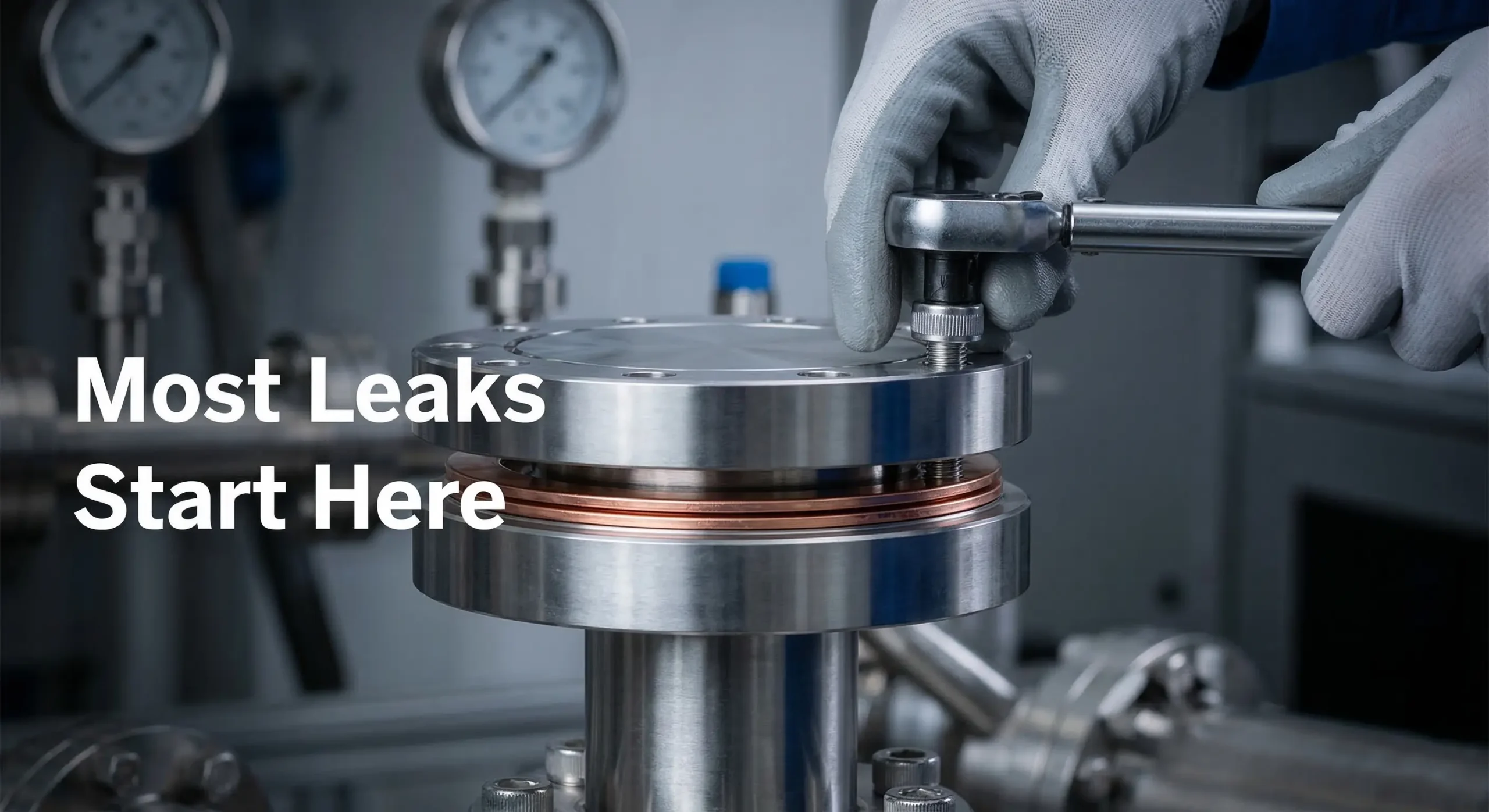
These are one of the most common sources of trouble. If sealing surfaces are scratched (even microscopically) or gaskets are installed incorrectly, a tiny imperfection can allow gas to enter the system, defying the pressure gradient.
While welding seems permanent, welded joints can become leak points if the weld quality is inconsistent or if thermal stress creates micro-cracks over time. A beautiful weld on the outside can hide a leak path.
This is another critical area. Because these components must combine fundamentally different materials—such as metal-to-glass or metal-to-ceramics—they experience significant mechanical and thermal stress that can weaken critical seals during operation or bake-out.
In many cases, troubleshooting is difficult because the leak itself is not visible at all.
One of the most confusing and time-consuming parts of vacuum troubleshooting is correctly understanding the difference between real leaks and virtual leaks. They often manifest identically.
A Real Leak: Allows external air to physically enter the system from the atmosphere through a physical opening.
A Virtual Leak: Is caused when gas is trapped in internal cavities or threaded connections (like the dead space at the bottom of a blind screw hole) and slowly, continuously escapes (outgasses) into the vacuum chamber.
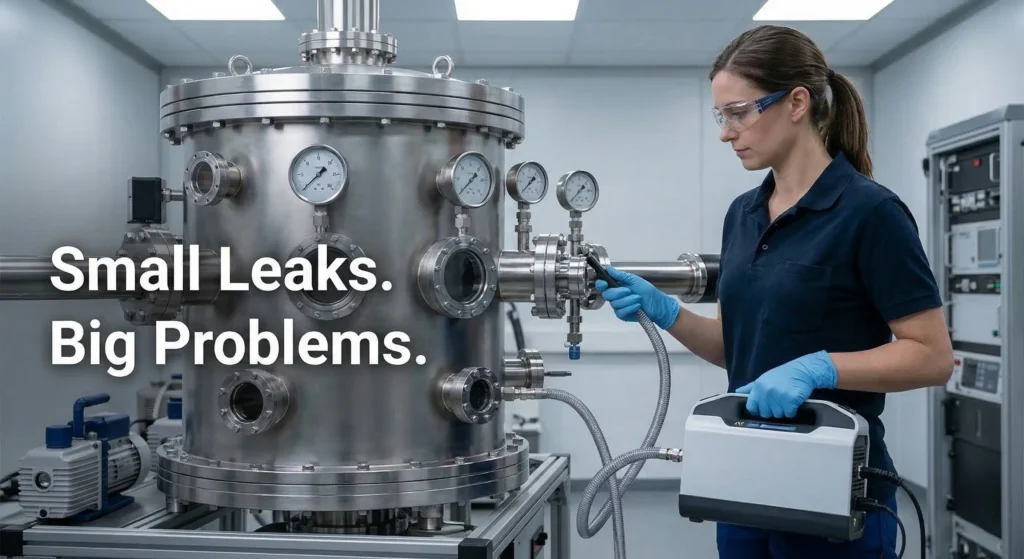
From the outside, both problems look the same: the system pressure refuses to drop to the expected level. But the solutions are entirely different—fixing a real leak requires sealing the opening, while fixing a virtual leak often requires disassembly, cleaning, and changing how components are vented or fastened internally.
A small leak might not catastrophically stop a vacuum system from operating, but it can degrade performance and introduce significant long-term costs.
The system may take hours longer to reach target pressure (pump-down time).
Processes become inconsistent and hard to replicate.
Sensitive experiments may fail due to unpredictable background contamination.
Over time, leaks force pumps to work harder and longer, reducing equipment lifespan and increasing utility and maintenance costs. In industries like semiconductor manufacturing, where absolute purity is required, even tiny leaks can compromise entire production cycles and result in millions of dollars of lost yield.
How Engineers Detect Vacuum Leaks
Experienced technicians rarely rely on guesswork or raw luck. Instead, they use structured, logical leak detection methods.
Structured Pressure Observation
The simplest diagnostic approach is observing how the system behaves under isolation. If the vacuum pressure rises steadily when the pump is isolated, it indicates a strong probability of a real leak or a significant outgassing problem (a virtual leak).
High-Sensitivity Helium Testing
For serious diagnostics and precise work, the industry standard is the helium mass spectrometer leak detector. These powerful instruments can quantify extremely small leak rates that would otherwise go completely unnoticed.
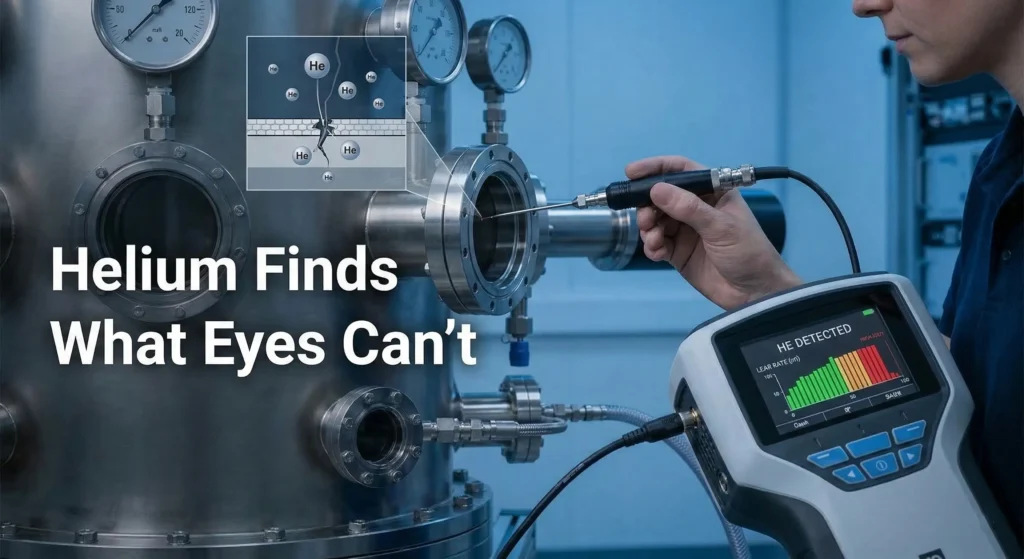
Helium is the ideal tracer gas because it is inert (non-reactive), extremely lightweight, rare in the atmosphere, and easy to detect using standard mass spectrometry. Technicians can spray a fine “puff” of helium externally around suspect areas, and if any enters the system, the detector instantaneously confirms the leak location.
While leak detection tools are powerful, preventing leaks from the very beginning of the system’s design cycle is far more effective than hunting them down later.
Highly reliable systems are engineered with prevention in mind, prioritizing quality from the start. This requires:
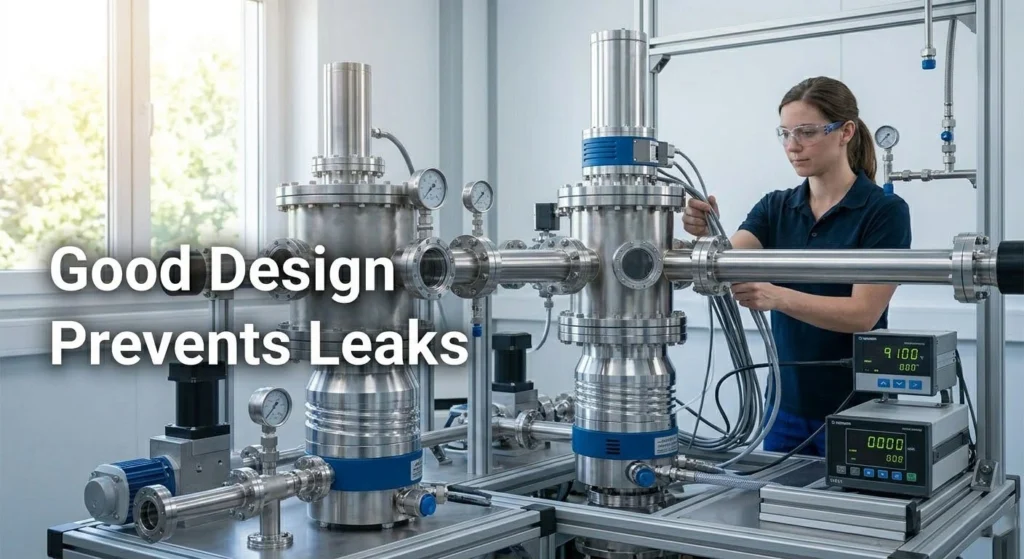
Precision-machined, high-quality flanges (such as ConFlat knife-edges).
High-performance, application-specific sealing materials (such as OFHC copper or tailored elastomers).
Standardized assembly procedures that include specific torque values.
The use of strictly clean assembly environments (avoiding dust and moisture).
Even simple, disciplined habits—like wearing gloves to avoid transferring outgassing fingerprints to internal or sealing surfaces—can make a significant, measurable difference in achieving ultimate base pressure.
Final Thought
Most vacuum leaks are not catastrophic, visible system failures. They are small, quiet imperfections that slowly, relentlessly degrade performance.
The difference between a stable, consistent system and a problematic, unpredictable one often comes down to the quality of assembly, the standard of the components used, and proper measurement methodology.
Engineers who understand the physics of leak behavior, how to differentiate real leaks from virtual ones, and how to use advanced measurement techniques can identify problems earlier and maintain their systems with much greater confidence. In vacuum technology, the smallest details often make the biggest operational difference.